
 UK
UK




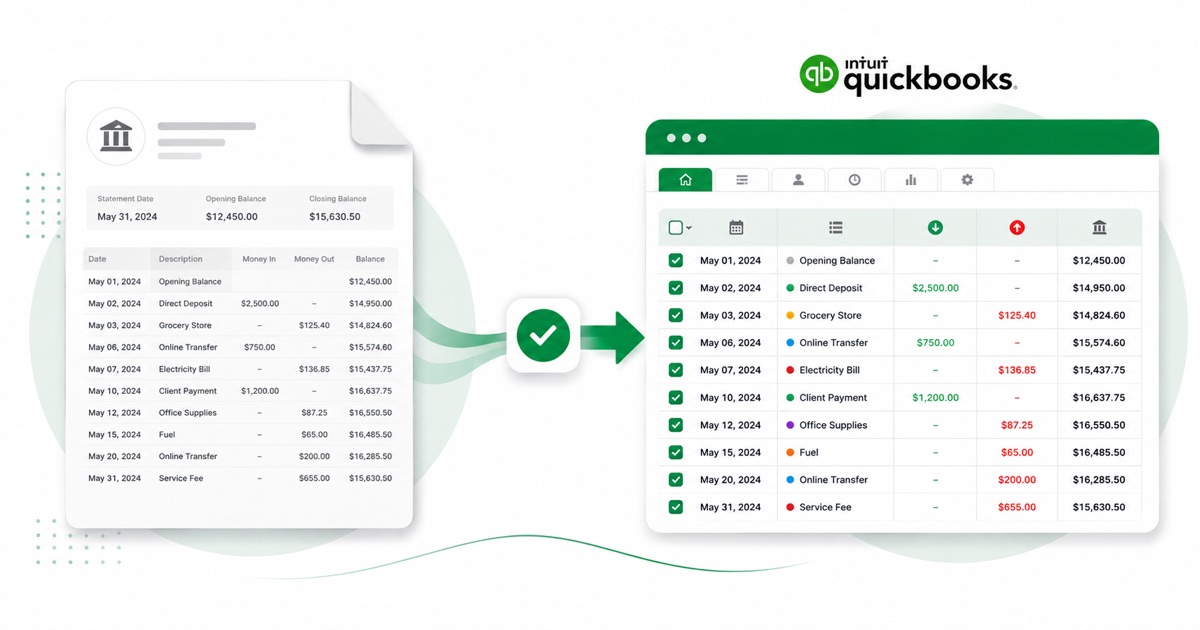
About Nationwide statements
Nationwide is the UK's biggest building society, owned by its members rather than shareholders. As a society account, the statement is still a standard PDF, downloaded from the Internet Bank or the Banking app, under Statements.
The part a copy-paste can't handle is the layout. Nationwide's transaction details often wrap onto a second line, laid out across its own money-out, money-in and balance columns. The converter reads all of that into its own columns instead of losing it.
Amounts stay in GBP (pounds) and dates keep the DD/MM/YYYY order — no quiet day/month swaps on the way out. If your only copy is a scan or a phone photo, that's fine — OCR handles it, and the totals still get reconciled.
After that you're just reconciling in QuickBooks; the awkward part of getting the data out of the PDF is handled.
Why people convert Nationwide to QuickBooks
A Nationwide feed into QuickBooks can lag by a few days or stop mid-month, leaving a gap right when you're trying to close. Converting the statement PDF hands you the exact period as an upload file, so the close isn't held up by the feed.
The common case is a bookkeeper handed a folder of Nationwide PDFs and told to "get these into QuickBooks." Converting each one is far quicker than retyping, and the balance check means you trust the totals before they land in the books.
Import a Nationwide statement into QuickBooks
QuickBooks Online takes a CSV; QuickBooks Desktop takes a .qbo Web Connect file.
- Convert the PDF above. For QuickBooks Online download the QuickBooks CSV; for Desktop download the QBO.
- QuickBooks Online: Banking → Bank transactions → Link account → Upload from file.
- Pick the CSV, map Date / Description / Amount, choose the account, and import.
- QuickBooks Desktop: File → Utilities → Import → Web Connect Files, then select the .qbo.
infoOne honest caveat
The QBO file carries a placeholder bank id, so QuickBooks Desktop can reject it with an OL-301 error ("not a participating financial institution") until you set your own bank's id. For a reliable import, use the QuickBooks CSV in QuickBooks Online instead — we don't claim the QBO will import everywhere.
The totals are checked first
The converter checks the maths before handing you the file — so if a transaction dropped out of the PDF, you know about it now, not when the QuickBooks balance is off.
Frequently asked questions
Will the Nationwide file import into QuickBooks?expand_more
In QuickBooks Online the CSV imports cleanly under Banking → Upload from file. The Desktop QBO can hit an OL-301 error ("not a participating financial institution") until you set your own bank's id — so for Online, stick with the CSV.
How is a Nationwide statement laid out?expand_more
Nationwide's transaction details often wrap onto a second line, laid out across its own money-out, money-in and balance columns. The converter reads each of those into its own column, so the QuickBooks-ready file imports into QuickBooks cleanly.
Where do I download the Nationwide statement?expand_more
From the Internet Bank or the Banking app, under Statements. Save the PDF, then drop it into the converter above — multi-page and multi-month statements are read in one go.
Can I use a photo of my Nationwide statement?expand_more
Yes. Scanned or photographed PDFs are read with OCR into the same columns, and the balance check still runs, so a scan converts the same as a digital download.
Do I have to pay up front?expand_more
Converting is free to start. Excel, CSV and JSON download with no login; the QuickBooks file needs a free sign-in.