
 AU
AU




About ING Australia statements
ING Australia is a branchless online bank, so statements are download-only from the app or site. The download from the app or website, under Statements is the record to convert — there's no posted statement to fall back on.
The part a copy-paste can't handle is the layout. An ING statement shows the monthly pattern behind its bonus interest — a set deposit and a run of card purchases — with the Savings Maximiser often alongside. The converter reads all of that into its own columns instead of losing it.
The figures stay in AUD (Australian dollars) and dates read DD/MM/YYYY, the same as on the original statement. A scanned statement is no problem; it's read with OCR into the same layout, with the balance checked either way.
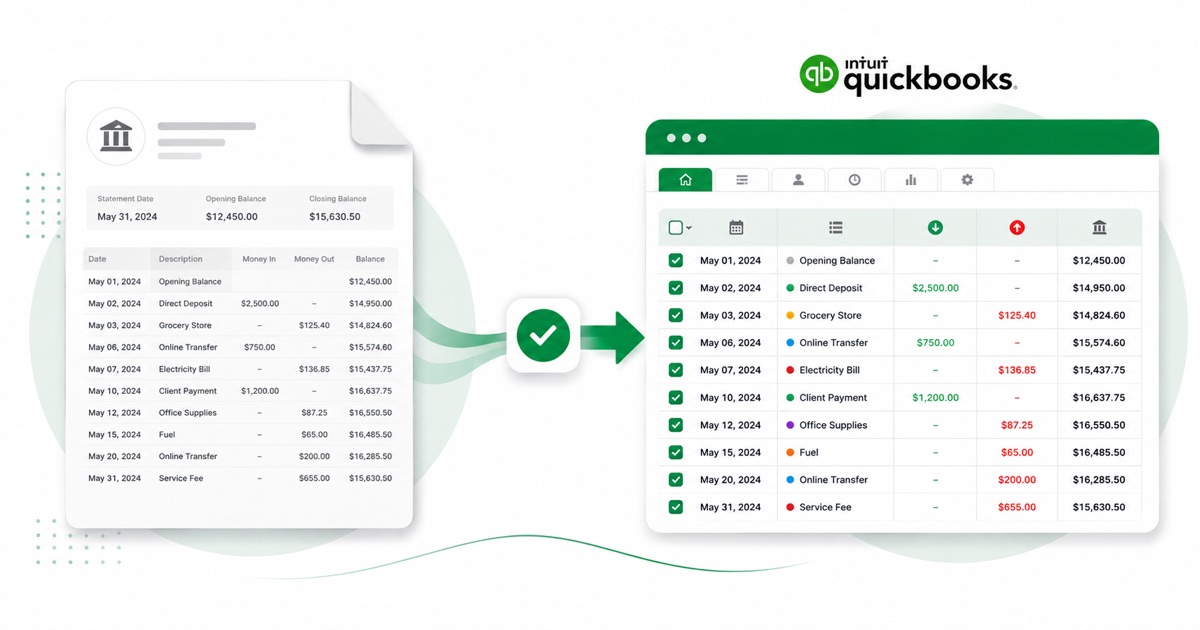
What lands in QuickBooks is a clean, checked file — so the only thing left is the reconciling you'd do anyway.
Why people convert ING Australia to QuickBooks
Not every ING Australia account is worth wiring a live feed to — a closed account, a rarely-used one, a single month you need on file. Converting the PDF is quicker than connecting a feed for a one-off, and it imports the same way.
It's handy mid-year too, not just at catch-up. A one-off ING Australia account, a statement the feed skipped, or a closed account you still need on file — convert the PDF and it goes into QuickBooks like any other import.
Import an ING Australia statement into QuickBooks
QuickBooks Online takes a CSV; QuickBooks Desktop takes a .qbo Web Connect file.
- Convert the PDF above. For QuickBooks Online download the QuickBooks CSV; for Desktop download the QBO.
- QuickBooks Online: Banking → Bank transactions → Link account → Upload from file.
- Pick the CSV, map Date / Description / Amount, choose the account, and import.
- QuickBooks Desktop: File → Utilities → Import → Web Connect Files, then select the .qbo.
infoOne honest caveat
The QBO file carries a placeholder bank id, so QuickBooks Desktop can reject it with an OL-301 error ("not a participating financial institution") until you set your own bank's id. For a reliable import, use the QuickBooks CSV in QuickBooks Online instead — we don't claim the QBO will import everywhere.
The totals are checked first
Before the QuickBooks-ready file downloads, the running balance is checked end to end. A missing or doubled line is caught at this step, not after it's already in QuickBooks.
Frequently asked questions
How does the ING Australia export get into QuickBooks?expand_more
In QuickBooks Online the CSV imports cleanly under Banking → Upload from file. The Desktop QBO can hit an OL-301 error ("not a participating financial institution") until you set your own bank's id — so for Online, stick with the CSV.
How is an ING Australia statement laid out?expand_more
An ING statement shows the monthly pattern behind its bonus interest — a set deposit and a run of card purchases — with the Savings Maximiser often alongside. The converter reads each of those into its own column, so the QuickBooks-ready file imports into QuickBooks cleanly.
Where do I get the ING Australia statement PDF?expand_more
From the app or website, under Statements. Export the actual statement PDF rather than screenshotting the transaction list — the PDF has the dates, amounts and balance the converter reads.
Can I use a photo of my ING Australia statement?expand_more
Yes. Scanned or photographed PDFs are read with OCR into the same columns, and the balance check still runs, so a scan converts the same as a digital download.
Do I have to pay up front?expand_more
Converting is free to start. Excel, CSV and JSON download with no login; the QuickBooks file needs a free sign-in.